Most sports bettors obsess over win rate. They track their record, celebrate winning streaks, and panic after losing runs. But professional bettors know that win rate alone tells you almost nothing about whether you're making good bets.
The metric that actually matters is Closing Line Value — and once you understand it, you'll never evaluate picks the same way again.
What Is Closing Line Value?
Closing Line Value (CLV) measures whether the price you bet at was better or worse than the final odds offered just before the game started.
The "closing line" is the last price a sportsbook offers before tip-off, puck drop, or first pitch. It's considered the most efficient price in the market — by that point, every major piece of information (injuries, lineup news, public money, sharp money) has been priced in.
If you consistently bet at prices better than the closing line, you're beating the market. Over thousands of bets, that edge compounds into long-term profit — even if your short-term win rate fluctuates.
A Simple CLV Example
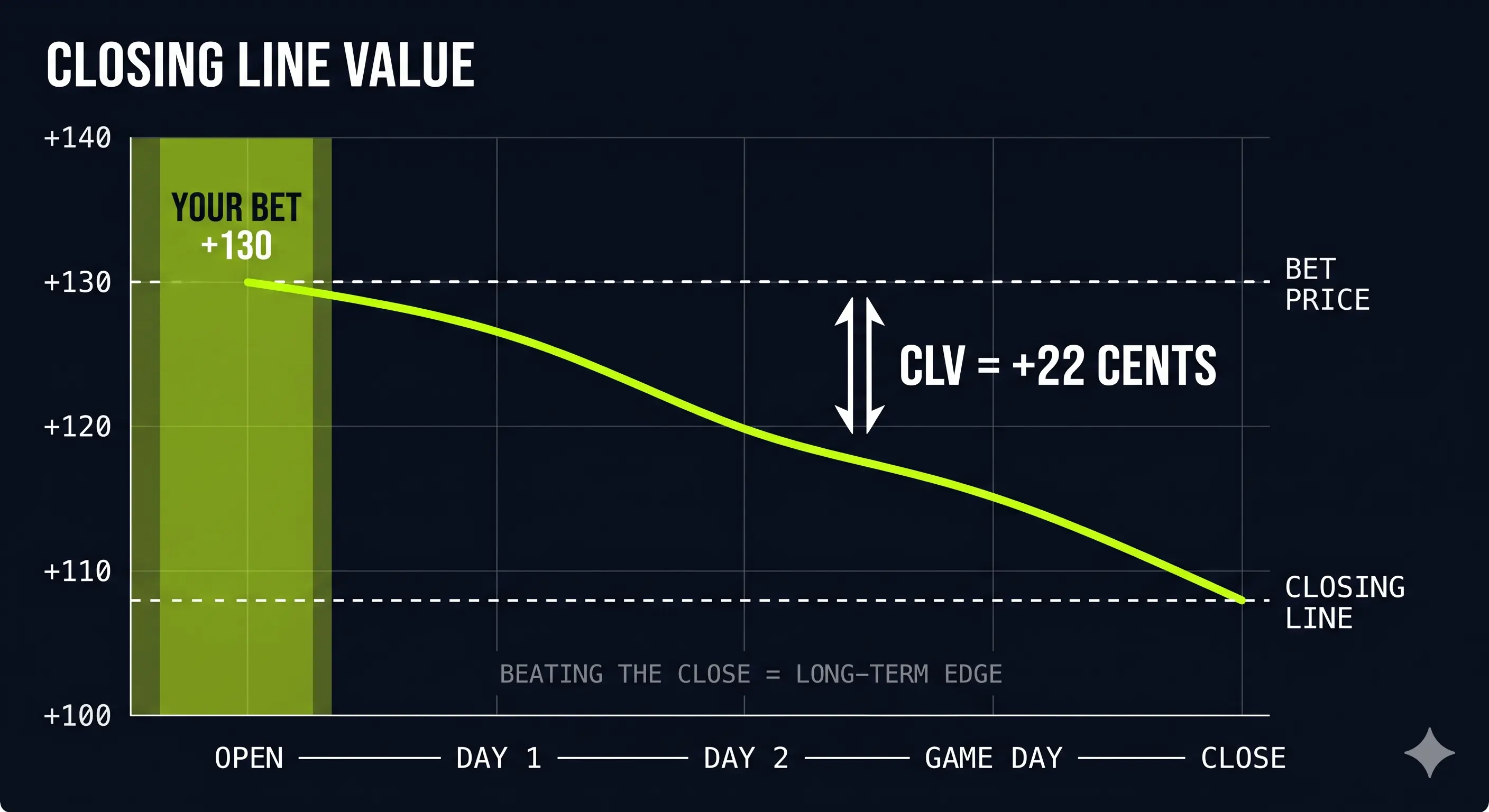
Closing line: Seattle Mariners +108
CLV = +22 cents in your favor
Result: ✅ Positive CLV — you beat the market
Notice that the result of the game doesn't appear in that calculation. The Mariners could win or lose — the CLV was already positive the moment you placed the bet at a better price than where the market settled.
Why CLV Matters More Than Win Rate
Sports betting is a game of small edges applied over large samples. A coin flip has 50% win rate and zero edge. A bet with 53% true probability might win 47% of the time over 50 games purely through variance — and look like a losing system.
CLV cuts through variance because it's measuring your edge at the moment of the bet, not the outcome. If the closing line consistently ends up worse than where you bet, the market is telling you that you had information (or found a price) that others didn't.
Professional betting syndicates track CLV obsessively. Many don't even focus on win/loss at all — they evaluate analysts purely on whether their picks beat the closing line.
Positive vs. Negative CLV
Positive CLV means you got a better price than the market ultimately agreed on. Your +130 became +108 at close — the market moved away from you, meaning sharp money came in after you on the other side, or the public pushed the line, or new information emerged. Either way, you had the better number.
Negative CLV means the market moved in your direction after you bet. Your -130 became -115 at close — the market got softer after your bet, suggesting the original price you paid was too expensive. Long-term, negative CLV bettors lose even when they're winning short-term.
How ZachAI Picks Tracks CLV
Every pick ZachAI releases includes a posted price and a minimum playable price. After games conclude, the system records the closing line and calculates whether the pick beat the market.
This CLV data feeds back into the model's scoring weights over time — markets and books where we've historically generated positive CLV get weighted more heavily. Markets where CLV has been flat or negative trigger additional scrutiny before a pick is released.
It's a continuous learning loop: release price → closing line → CLV → model weight adjustment → next pick.
How to Apply CLV to Your Own Betting
You don't need sophisticated software to start tracking CLV. After every bet, note the closing line and compare it to where you bet. Keep a simple spreadsheet:
- Date, game, your price, closing price
- CLV per bet (positive = you beat the close, negative = you didn't)
- Rolling average CLV over your last 50 bets
A positive average CLV of even +3 to +5 cents is a strong indicator of a healthy process. Most recreational bettors have negative CLV — they bet late, take worse prices, and follow public money that's already moved the line.
The Fastest Way to Improve Your CLV
Three habits that immediately improve CLV:
- Bet earlier when you have information advantages. Early lines are set by the book, not the market. Sharp bettors hit early numbers before the market corrects them.
- Shop multiple books. The best available price across DraftKings, FanDuel, and Caesars is almost always better than any single book's price. That difference is free positive CLV.
- Never bet into a line that's already moved against you. If the market moved from +110 to +102 and you're still looking at +102, the easy money is gone. PASS and find a fresh spot.
Every pick we release includes a minimum playable price. If the line has moved past that threshold by the time you see the pick, we tell you not to bet it. That's CLV protection built into the release.
The Bottom Line
Win rate is a lagging indicator — it tells you what happened. CLV is a leading indicator — it tells you whether your process is sound. Build a system that consistently generates positive CLV, and the wins will follow over time.
That's the core philosophy behind ZachAI Picks. We don't chase win percentages. We chase market edge — and let the results reflect that discipline over a long sample.