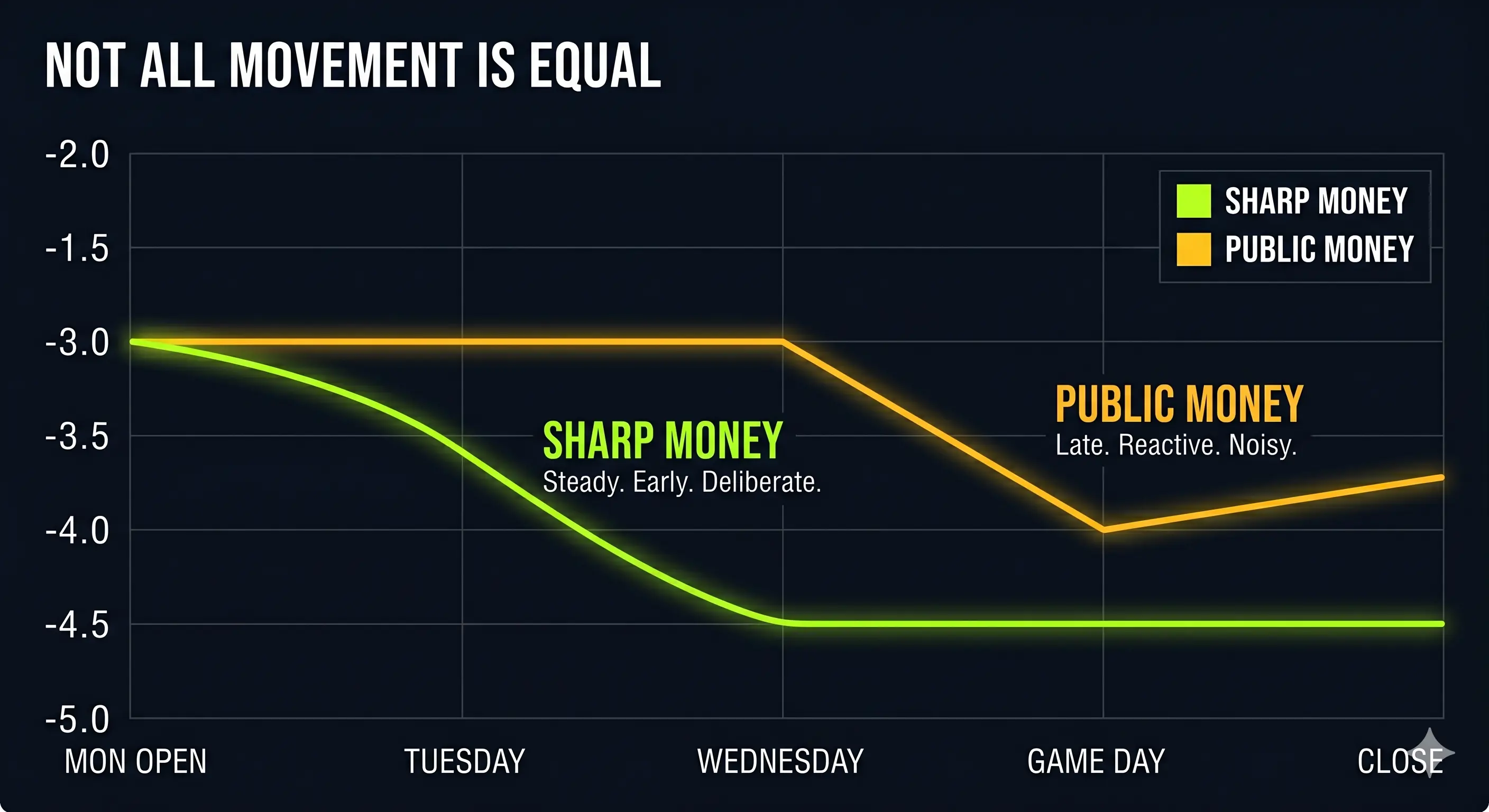
A line moves five points in 24 hours. Is that good news or bad news for your bet? The answer depends entirely on why it moved — and most bettors get this wrong.
Line movement is one of the most misread signals in sports betting. The surface information (line went up, line went down) tells you almost nothing on its own. Understanding the source of that movement is where real edge lives.
Why Lines Move at All
Sportsbooks set opening lines to balance action — they want roughly equal money on both sides so they collect the vig regardless of who wins. When more money comes in on one side, the book adjusts the price to attract action on the other side and restore balance.
Simple, right? The complication is that "more money" can come from two very different sources with opposite implications for your bet.
Public Money vs. Sharp Money
📢 Public Money
- Recreational bettors betting on popular teams
- Follows media narratives and recent results
- Usually concentrated on favorites and overs
- Often wrong over large samples
- Predictable — books anticipate it
🎯 Sharp Money
- Professional bettors with track records
- Based on model outputs and real information
- Can hit either side regardless of popularity
- Correct more often than the market predicts
- Books move quickly to limit sharp exposure
The same line movement — say, a team going from -3 to -4.5 — can mean completely opposite things depending on who caused it.
Reading the Pattern: Four Key Scenarios
1. Line moves with the public (fade candidate)
→ Public money pushed the line. Cowboys are now overpriced.
→ Contrarian value may exist on Giants +4.5.
When a popular team's line keeps moving in their favor despite heavy public backing, the book may be "shading" the line knowing they'll get action regardless. Fading public consensus when lines have moved significantly can find value — but this is a blunt tool that requires confirmation.
2. Line moves against the public (sharp signal)
→ Line moved AWAY from the public side despite majority action.
→ Sharp money hit Team B hard enough to move the line against the crowd.
→ Team B has sharp support.
This is the most valuable signal in sports betting. When a line moves opposite to the public bet percentage, it almost always means sharp money came in on the unpopular side. Books don't move lines against their own financial interest without a reason.
3. Late movement (injury or news-driven)
→ Sudden late movement usually = news (injury, weather, lineup change)
→ If you haven't seen the news, you're betting blind on the old price.
Late line movement is the most dangerous for recreational bettors. You see a great price and jump on it — not knowing that the line moved because the starting quarterback just got scratched. The book knows. Sharp bettors know. You don't.
4. Flat line despite one-sided action (book confidence)
→ Book is comfortable holding the liability.
→ They expect public-side to lose. Not a fade signal — just market stability.
How ZachAI Uses Line Movement
Every pick scored by ZachAI is evaluated against three movement signals:
- Opening line vs. current line — did the market move toward or away from our pick since open?
- Delta magnitude — how large was the move? A 3-point swing is very different from a half-point.
- Snapshot count — how many data points confirm the movement trend? Single snapshots are noise; a consistent directional trend is signal.
Movement toward our pick adds to the score. Movement against our pick deducts — and beyond a threshold, triggers a hard block regardless of other factors. The Carolina Hurricanes game on April 13 is a perfect example: the line moved $30 against our pick, which would have blocked the bet under the updated model.
If a line has moved more than 1.5 points (spread) or $20 (moneyline) against your intended bet since open — and you don't have a clear reason why — PASS. The market knows something you don't.
The Timing Edge
One of the most underrated applications of line movement is timing. ZachAI Picks releases 60–90 minutes before game time specifically because that's when the market is most accurate — all meaningful injury news has been priced in, sharp money has moved lines to fair value, and you're getting the most accurate price available.
Betting three days early on a game looks smart until the starting pitcher gets scratched the morning of. Waiting for the market to fully process information is a form of risk management.
The Minimum Playable Price
Every ZachAI pick includes a minimum playable price. If the line moves past that price before you place your bet, you should not bet it. That minimum is calculated based on where the value existed when the pick was released — if the market has priced that value away, the edge is gone even if the pick was good at release time.
This is line movement protection built directly into every release. Most pick services ignore this entirely — they release a pick and never tell you when it's too late to take it.